
What Is Traditional Chinese Medicine?
What Is Traditional Chinese Medicine?
At Wellness For All Creatures we most often work with Acupressure; the information below is provided for those who would like a broader understanding of TCM and its principals.
Traditional Chinese medicine (TCM) is an ancient medical system that takes a deep understanding of the laws and patterns of nature and applies them to the human body. TCM is not "New Age," nor is it a patchwork of different healing modalities. TCM is a complete medical system that has been practiced for more than five thousand years. At the heart of TCM is the tenet that the root cause of illnesses, not their symptoms, must be treated.
In modern-day terms, TCM is holistic in its approach; it views every aspect of a person (body, mind, spirit, and emotions) as part of one complete circle rather than loosely connected pieces to be treated individually.
Major TCM Session Modalities
Often Western CAM practitioners and their patients or clients derive their understanding of TCM from acupuncture. However, acupuncture is only one of the major session modalities of this comprehensive medical system based on the understanding of Qi or vital energy. These major session modalities are:
- Qigong: an energy practice, generally encompassing simple movements and postures. Some Qigong systems also emphasize breathing techniques.
- Herbal Therapy: the use of herbal combinations or formulas to strengthen and support organ system function.
- Acupuncture: the insertion of needles in acupoints to help Qi flow smoothly.
- Acupressure: the use of specific hand techniques to help Qi flow smoothly.
- Foods for Healing: the prescription of certain foods for healing based on their energy essences or energy signatures, not nutritional value.
- Chinese Psychology: the understanding of emotions and their relationship to the internal organ systems and their influence on health.
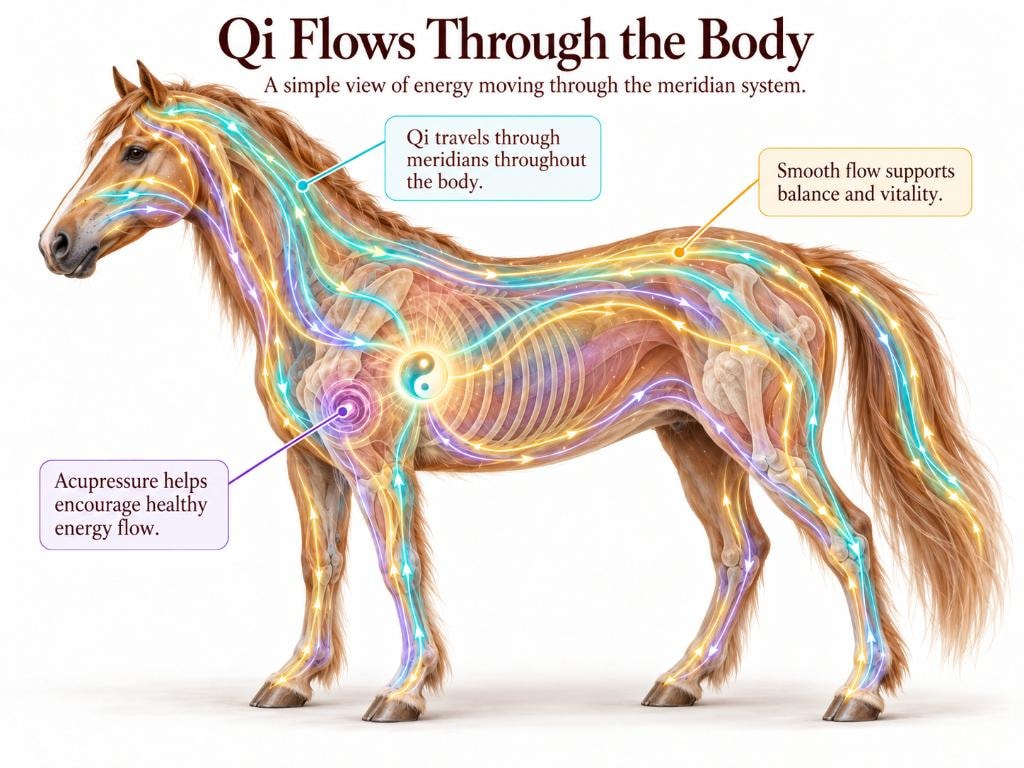
The Theory of Qi
The true foundation of TCM is Qi, which is loosely translated as vital energy. In TCM, Qi is considered to be the force that animates and informs all things. In the human body, Qi flows through meridians, or energy pathways. Twelve major meridians run through the body, and it is over this network that Qi travels through the body and that the body's various organs send messages to one another.
Qi has two aspects: one is energy, power, or force; the other is conscious intelligence or information. Each Organ System carries its own unique Qi, which allows it to perform its unique functions — both physical (which Western medicine can describe) and energetic (which Eastern medicine can identify).
TCM frequently references several major Qi problems. One is an overall "Qi deficiency," which is often described in Western medical terms as chronic fatigue syndrome (CFS). Another major condition is "Qi stagnation," which means energy and information cannot move smoothly to or from its appropriate location. TCM considers pain, headache and stomachache the result of Qi stagnation.
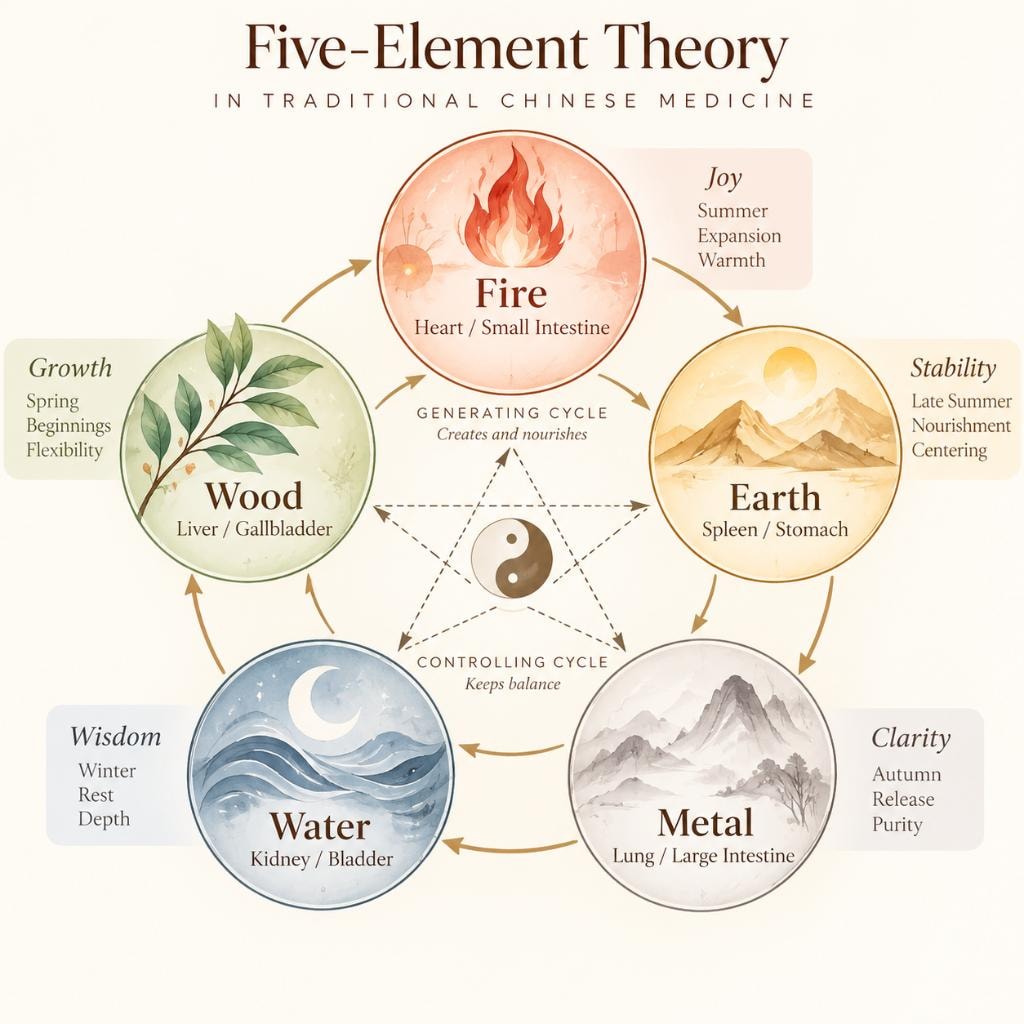
Five-Element Theory
TCM believes that the human body is a microcosm of the Universal macrocosm. The Five-Element Theory is the bedrock of TCM. It evolved as a way of naming and systematizing patterns of perceived related phenomena into five major groups named for the universal elements: Wood, Fire, Earth, Metal and Water.
The Five-Element Theory states that the five major Organ Systems (Liver/Gallbladder, Heart/Small Intestine, Spleen/Stomach, Lung/Large Intestine, and Kidney/Urinary Bladder) are each related to a particular element and therefore to a broad category of correspondences — from a season of the year to a time of day, to particular colors and foods.
Meridian Theory
Meridians, or channels, are invisible pathways through which Qi flows that form an energy network that connects all parts of the body, and the body to the universe. TCM understands that our body has twelve major meridians, each related to a specific Organ System.
The meridian network is like a system of highways, roads and streets that links major cities. It is through this system of roadways that energy (Qi) runs. Blockages in meridians can cause problems in organs — just as traffic congestion on a highway eventually affects the cities it connects.
"As long as Qi flows freely through the meridians and the Organs work in harmony, the body can avoid disease."
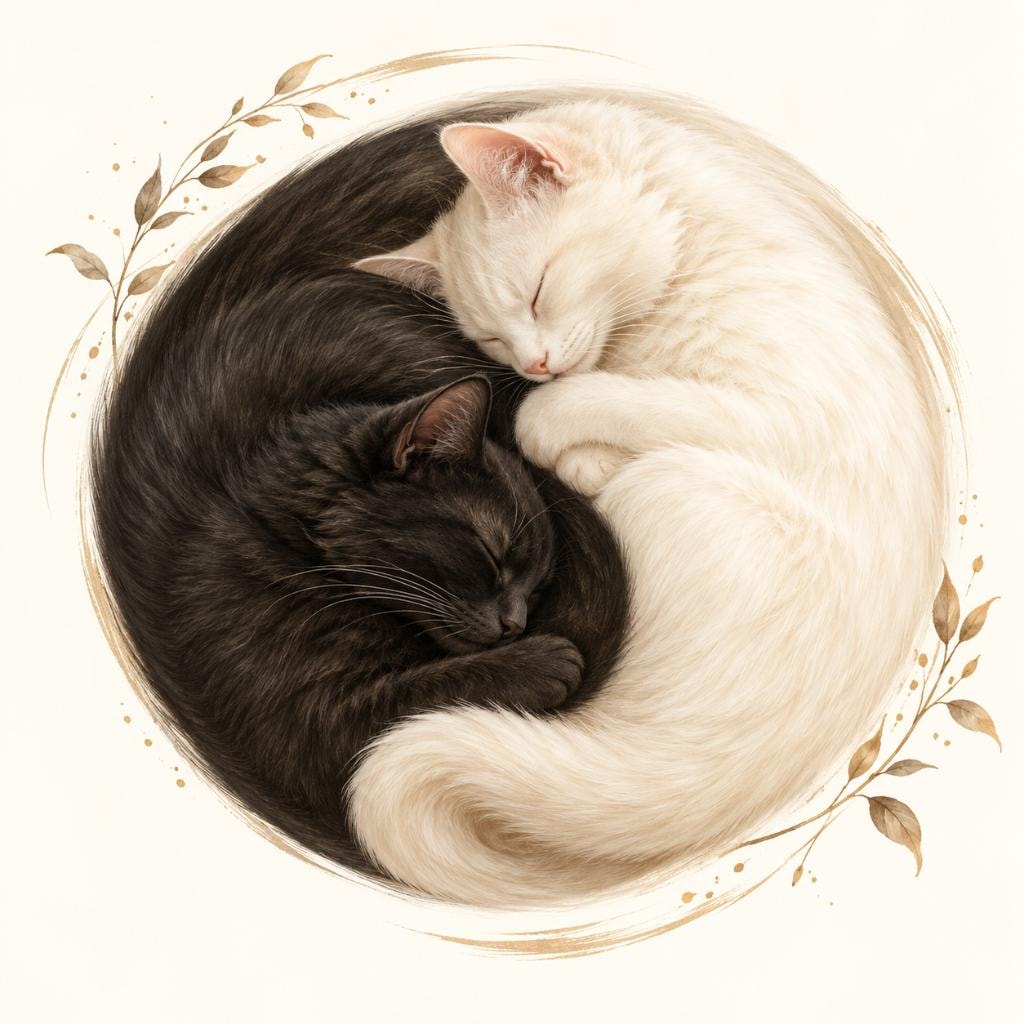
Yin/Yang Theory
TCM understands that everything is composed of two complementary energies; one energy is yin and the other is yang. They are never separate; one cannot exist without the other. This is the yin/yang principle of interconnectedness and interdependence — it is not oppositional.
In TCM, "harmony" is the ultimate goal — not merely balance. When two things are in harmony, their energies are not just equally proportioned but blended together into a seamless whole. When one predominates, the other recedes; this is homeostasis: internal harmony that is a dynamic condition.
Copyright © 2005–2011 Traditional Chinese Medicine World Foundation